
Press Releases
Drawing Eduardo Pavez | Black-chested Buzzard-eagle (Geranoaetus melanoleucus)
The Journal of Raptor Research highlights 2-3 articles per issue. Our Science Writer, Zoey T. Greenberg, writes corresponding press releases to optimize exposure for the selected works, archived here beginning with most recent. For questions please reach out to science.writer@raptorresearchfoundation.org
Issue 3, 2026
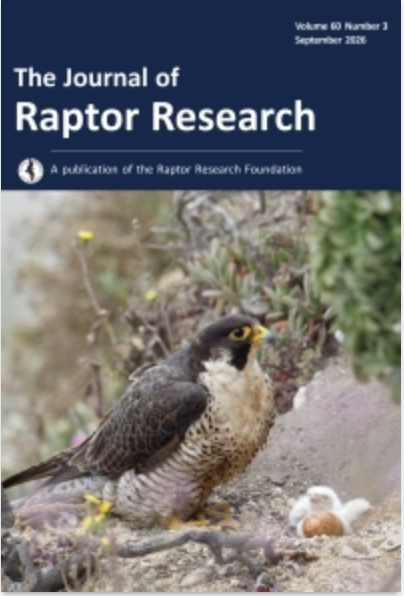
First DDT Now the Flu: Peregrine Falcons in San Francisco Bay Area Hit Hard by H5N1 VariantHighly Pathogenic Avian Influenza (HPAI) featured prominently in the news during 2020 as it took the lives of millions of birds across the globe. While the worst seems to be behind us, population-level effects are just now emerging. A new study published in the Journal of Raptor Research, titled “Rapid Decline of Nesting Peregrine Falcons in the San Francisco Bay Region of California Synchronous with an Outbreak of H5N1 Highly Pathogenic Avian Influenza,” reports an alarming decrease in the number of occupied territories for a population of Peregrine Falcons (Falco peregrinus) that has maintained a longstanding presence in coastal California. As top predators, peregrines show warning signs when the health of their food web is jeopardized. They indicated the threat of DDT to wildlife in the 1960’s, and they are once again sounding the alarm to those who know where to look.
| Turbine Tactics: Biologists Successfully Alert Golden Eagles to Wind Turbines Using New Deterrent SystemWind farms have received heat in recent years for their potential to harm wildlife, a notable issue in western North America where some farms are located near populations of protected Bald Eagles (Haliaeetus leucocephalus) and Golden Eagles (Aquila chrysaetos). A new study published in the Journal of Raptor Research titled “Behavioral Responses of Large Soaring Raptors to Audio Deterrents at Commercial Wind-Energy Facilities in the Western USA” found that outfitting turbines with devices that emit warning sounds to approaching raptors can effectively reduce the number of collisions, and therefore deaths, at wind energy sites. For large soaring birds like eagles, hawks, and vultures, this is an especially valuable finding and offers a positive development for a long-standing conservation challenge. | Eagles Known as Hunting Specialists Surprise Researchers by Feeding on Goat CarcassEagles are symbols of hunting prowess. Known as top predators wherever they live, it is often assumed that killing is their primary mode. However, a new study published in the Journal of Raptor Research reports the first confirmed case of sustained carrion use by Verreaux’s Eagles (Aquila verreauxii) in the Arabian Peninsula, suggesting that the species’ diet may be more adaptable than previously realized. At a time when food webs are shifting and habitat health is in constant jeopardy, evidence of flexibility in top predators bolsters our understanding of how raptors can or cannot adapt to their changing environment.
|
Issue 2, 2026

Girl Power: Hawk Parents Invest More in Female OffspringFew among us appreciate being called cheap, yet this term has a useful application in bird world. A new study published in the Journal of Raptor Research, “Factors Influencing Nestling Sex Ratios of Suburban and Rural Red-Shouldered Hawks, 2004-2016,” finds that male Red-shouldered Hawks (Buteo lineatus) are the cheaper of the sexes, meaning hawk parents prioritize producing female offspring when conditions are optimal. This means that higher quality territories could result in more females, offering biologists clues about habitat health, which is important intel as the species adapts to urban environments with increasing frequency.
| Batty Behavior: Falcon Seen Feasting on Atypical Prey Species in GreeceFalcons are lauded for their speed and agility. The Eurasian Hobby (Falco subbuteo), skilled at snagging birds and insects out of the air, is no exception. However, during twilight on one fateful day in October, researcher Apostolos Christopoulos observed several hobbies feeding on something else in a protected wetland in Greece — bats from the genus Pipistrelus. Bat predation by Eurasian Hobbies has only been recorded a handful of times before and the species is relatively unstudied, making this discovery an illuminating one. Migration is an energetically demanding time of year for all raptors and understanding which prey items feature in a species’ refueling strategy can have strong conservation implications. This observation suggests that bats may offer critical caloric support for migrating hobbies, especially in wetland-urban habitats. | Vultures on the Rise: New Study Provides Evidence of Population Increase and Delayed Migration in Western North AmericaTurkey Vultures (Cathartes aura) may not be beautiful, but they are certainly adaptable. A new study published in the Journal of Raptor Research, titled “Turkey Vulture Aggregations at a Water Barrier Provide Evidence of Later Migration and Increasing Population Size over 25 Years” suggests that Turkey Vultures in western North America are increasing in number and delaying their migration departure date. Both findings could be correlated with climate change, although more investigation is needed to confirm. This study presents a new counting method that could prove useful for studying other soaring raptor species, especially at topographical “bottlenecks” like large water crossings.
|
Issue 1, 2026
Travel far, breed hard, and die young: Short-eared owls and why we should study themThe newest issue of The Journal of Raptor Research is a special issue focused on movement ecology — how and why raptors move. This can include classic movements like migration, as well as nomadism. Short-eared Owls (Asio flammeus) fall into the latter category — they have a penchant for small mammals that breed in “boom and bust” cycles approximately every four years. Therefore, these owls must travel great distances to find prey in sufficient numbers. This requires a high degree of nuanced perception, yet we know very little about the actual mechanisms that allow an owl to accurately locate these peaks in prey cycles. A feature article in the new issue, titled “Irruptive Movements by Short-eared Owls and Concepts of Habitat Use: Commentary and Suggestions to Address Information Gaps,” emphasizes the need for more understanding about this phenomenon, and proposes eight research questions to guide future work. Changing climate regimes can severely impact where and when small mammals show up on the landscape, especially in the tundra, where many predators rely up on their presence. There is an increased need for conservation leaders to understand the decision-making of species whose survival is linked to these ephemeral pulses in prey, and owls are a strong choice for future investigation. | We call them layovers, birds call them stopoversBird migration is awe-inspiring. Animals mostly made of feathers take to the sky and complete round-trip journeys up to 40,000 kilometers long. The extremists migrate nonstop. Some fast the entire way. Most migratory species, however, engage in what ornithologists refer to as “stopovers” to refuel, rest, and wait out storms. A new literature review published in the Journal of Raptor Research emphasizes the need for more investigation into the importance of these stopover sites, newly defined in the review as places where individuals “pause their migratory movements for at least twenty-four hours.” Raptors are top predators with far-reaching impacts on their surrounding habitat, and they respond quickly to environmental change, making them effective bioindicators. Bolstering our knowledge of which areas are most crucial to the success of these long-distance journeys is therefore necessary, and increasingly possible as tracking technology improves. | Birds of a feather sleep together: Use of communal roosts by a charismatic RaptorBirds, like other animals, need safe and warm places to sleep. Cozying up in groups can be an effective way to maintain vigilance, conserve heat, and gather information about where to find their next meal. A new study published in the Journal of Raptor Research titled “Use of GPS Telemetry System to Study Communal Roosts in a Neotropical Raptor”tracked 24 Chimango Caracaras (Milvagro chimango) to study their resting, or “roosting” behaviors during the breeding season. Studies like this shed light on what is called the “spatial ecology” of an animal, meaning how organisms are distributed, how they use and move through space, and how interactions between other caracaras and other species unfold as a result. Such information helps biologists understand the importance of particular habitats, as well as how species adapt to changing landscapes. |

Golden Eagles in the West appear stable, but Nevada tells a different storyGolden Eagles (Aquila chrysaetos) have been protected in North America since 1962 and their populations in the West are considered stable. However, a new study published in the Journal of Raptor Research found that the Nevada population is declining and could be headed for something worse. This paper, titled “Estimating Survival and Population Trajectories of Golden Eagles in Nevada,” suggests that Nevada may be a population sink — an area with conditions unsuitable for maintaining a stable population of Golden Eagles. Most studies on the population health of this species have focused on adult eagles, however this paper underscores the importance of including nonbreeding individuals in such assessments to better understand who exactly is contributing to the population and how impacts to immature eagles may ultimately undercut the breeding adult population. In Nevada, too many local eagles are dying to support a stable population. How then, do eagles keep showing up on nesting territories? | What happens to eagles after rehab?There are many ways for an eagle to suffer a human-caused death. Electrocution, lead poisoning, vehicle collisions, or being shot, to name a few. Some of these deaths are “offset” through a provision within the Bald and Golden Eagle Protection Act of 1962 (BGEPA) that requires eagles to be replaced when they are removed from the population by certain human actions. A recent study published in the Journal of Raptor Research, titled “Post-release Survival of Golden Eagles in Western North America Following Clinical Rehabilitation from Injury and Disease,” found that releasing rehabilitated Golden Eagles (Aquila chrysaetos) back into the wild could be an effective means of compensating for eagle deaths that occur as a result of otherwise legal actions, such as those associated with energy infrastructure. These results are part of a continuous effort to try and stabilize Golden Eagle populations throughout their range and understand the efficacy of rehabilitation efforts for the species in general. |
Issue 3, 2025

Home is where the airfields are: What happens when hawks are moved from Los Angeles airportsTo a hawk an airport can look like the perfect place to settle down. The layout provides ample open space, perches, and nice habitat for a variety of prey species. However, congregations of birds, especially big birds, poses a safety issue for aircraft. A new study focused on Cooper’s Hawks (Accipiter cooperii), published in the Journal of Raptor Research, found that removing a hawk from an airfield and taking it somewhere else, called translocation, can serve as a method for reducing this risk. | Statistical model correctly predicts nest success for the critically endangered California CondorCalifornia Condors (Gymnogyps californianus) raise their young in crazy places. Cliffsides or rockfall on the sides of mountains are the typical haunts of condor families, making nest monitoring difficult for even the most intrepid field biologists to achieve. A new paper titled “Modeling Individual-level and Population-level Nest Success of California Condors from Movement Data,” published in the Journal of Raptor Research, demonstrates the efficacy of using statistical modeling paired with GPS tracking to remotely determine whether condor nests are successful. | Wanderlust of Bald Eagles intrigues researchers in ArizonaBirds of feather don’t always flock together, despite the adage. A recent study published in the Journal of Raptor Research tells the story of Arizonan Bald Eagles (Haliaeetus leucocephalus) engaging in intriguing migrations by traveling north rather than south, contrary to most migratory birds in temperate zones. The paper, titled “Northward Migrations of Nonbreeding Bald Eagles from Arizona, USA,” also highlights one eagle who chose to leave Arizona and settle in California, a behavior that challenges previous understandings about emigration in this population. |
Issue 2, 2025

Illegal poisonings imperil European raptors and could disrupt ecosystem healthA recent comprehensive assessment on the poisoning of raptors across Europe does not yield good news. This is according to the new paper “Poisoning in Europe Between 1996 and 2016: A Continental Assessment of the Most Affected Species and the Most Used Poisons,” published in the Journal of Raptor Research. A large team of raptor researchers amassed retrospective data on poisoning events across 22 European countries between 1996 and 2016. Carbofuran and aldicarb were the most common toxins reported and disproportionately affected scavenging raptors, especially in Northern Europe. As high-level participants in trophic interactions and providers of ecosystem services, raptors are crucial agents of Europe’s ecological health. These poisonings are, therefore, troubling. They are also illegal. | Making moves and hitting the breaks: Owl journeys surprise researchers in western MontanaResearchers tracked 89 Northern Saw Whet Owls (Aegolius acadicus) along a migration corridor in Western Montana, underscoring the efficacy of telemetry studies for detailed investigations into the movements of birds. Their paper, “Migration and Roosting Behavior of Northern Saw-whet Owls (Aegolius acadicus) During Fall Migration in Western Montana,” was published in the Journal of Raptor Research. The research team was surprised to discover that owls demonstrated stopover behavior, meaning pauses along migration for resting and refueling, as well as notable individual variation in their direction and method of travel. These findings further unveil the migration story of North America’s smallest owl, which may accelerate research on movements of other owl species as well. | New study refocuses research on mysterious falcon declineNorth America’s smallest falcon, the American Kestrel (Falco sparverius), has declined across the continent since the 1970s, yet the causes continue to stump raptor biologists. A new study published in the Journal of Raptor Research adds a piece to the puzzle with the discovery that in the Northeast, where declines are most alarming, fledglings demonstrate a relatively high survival rate. This paper, titled “Juvenile and Adult Survival Estimates of American Kestrels Throughout the Full Annual Cycle in Eastern North America,” is the first of its kind. No other study has assessed winter survival rates for kestrels at northern latitudes, fledgling survival following nest departure for both males and females, or tracked individual kestrels through multiple seasons in migratory and residential populations. These breakthroughs may help redirect future studies to untapped arenas of inquiry. |
Issue 1, 2025

Wind power development affects entire raptor communities, not just individualsCollisions with wind turbines are a documented threat to the lives of individual raptors. However, wind development also impacts the structure of nesting raptor communities, a discovery that could impact approaches to raptor conservation in the future. This is according to a new paper “Long-Term Changes in Nesting Raptor Communities After Construction of Wind Power Projects,” recently highlighted in the Journal of Raptor Research. The research team confirms that several sensitive raptor species nesting along the border of Oregon and Washington, including Golden Eagles (Aquila chrysaetos), have decreased in abundance on wind power project sites. Other species, like Great-horned Owls (Bubo virginianus), have increased. | Thriving between the lines: How protected areas are helping a threatened owlSpotted Owls (Strix occidentalis) have faced a collage of challenges for decades. A new study provides evidence that designated protected areas are helping the Mexican Spotted Owl subspecies (Strix occidentalis lucida) maintain a foothold in the Southwestern United States. These results were published in the Journal of Raptor Research in the paper “Testing the Efficacy of Protected Areas: Use of Protected Activity Centers by GPS-Tagged Mexican Spotted Owls.” Given the current dynamism of global climate conditions, understanding the functionality of protected areas is an important part of supporting vulnerable wildlife species, especially in arid regions. | National conservation area in Idaho supports top predatorDespite widespread declines in North American grassland bird populations over the last fifty years, a falcon species on a conservation area in Idaho appears to be holding strong. This is according to the new paper “Prairie Falcon (Falco mexicanus) Abundance in a National Conservation Area in Idaho Has Increased since the 1970s-1990s,” highlighted in the current issue of the Journal of Raptor Research. A team of collaborators from Boise State University and the U.S. Geological Survey conclude that Prairie Falcons nesting and foraging in the Morley Nelson Snake River Birds of Prey National Conservation Area (NCA) in Southwestern Idaho have increased in abundance and maintained nesting success over a 45-year period. This suggests efficacy of the NCA as a refuge for Prairie Falcons and offers a glimmer of relief for raptor conservationists. |
Issue 4, 2024

Turkey vultures indicate rodenticide prevalence near Los Angeles, California, despite state-wide bansTurkey Vultures (Cathartes aura) in southern California are still exposed to anticoagulant rodenticides (ARs) even though legislation was passed to drastically reduce the presence of these poisons across the state. This is according to the short communication “Turkey Vultures (Cathartes aura) from Southern California are Exposed to Anticoagulant Rodenticides Despite Recent Bans,” recently published in the Journal of Raptor Research. The harmful nature of these rodenticides is what led to their ban in California. If they are persisting, this could spell trouble for additional non-target wildlife species including those with an endangered status like the Burrowing Owl (Athene cunicularia). | Some hawks pack a punch: Secrets behind nest defense revealedStories about hawks and owls attacking people have made the news in recent years. However, there is more to these attacks than meets the eye. Authors of a new paper published in the Journal of Raptor Research illuminate this backstory in “Nest Defense Behavior of Suburban and Rural Red-shouldered Hawks.” Nest height plays a role in the defensive mentality of individual Red-shouldered Hawks (Buteo lineatus), as well as how familiar they are with human intrusions. Interestingly, personality could also be a factor — some hawks are just sassier than others. | Destigmatizing drones: How they can aid raptor biologists around the worldClimbing a giant tree with a harness and a helmet is one way to check on an eagle nest, but there are other ways. Drones offer an efficient, safe, and hands-off option for surveying raptor nests, according to a Conservation Letter recently published in the Journal of Raptor Research titled “The Use of Drones in Raptor Research.” Following an extensive literature survey, authors of the letter make a compelling case for drone usage in nest studies for various raptor species. |
Issue 3, 2024

Hit or miss: Collisions affect raptors on a global scaleWhat do windows, vehicles, power lines, fences, communication towers, wind turbines, and airfields all have in common? They block the flight path of raptors — sometimes with fatal consequences. According to a new Conservation Letter published in the Journal of Raptor Research, collisions pose a conservation threat to raptors globally. While there is much to learn about population-level effects, it is clear from rehabilitation and veterinary records that collisions are a common issue for these winged top predators in rural, suburban, and urban settings. | Two billion termites in two weeks: How Amur falcons cross the Arabian SeaOne million Amur Falcons (Falco amurensis) can consume two billion termites in just over fifteen days. This is according to a paper published in the newest issue of the Journal of Raptor Research. These numbers are big, and the conclusions are even bigger — Northeast India provides a crucial stopover site for these falcons as they prepare to cross the Arabian Sea, a flight that earns them the title of the raptor with the longest known flight over water. | Hawk defies expectations in the face of habitat declineFerruginous Hawks (Buteo regalis) that spend their winters in California seem to be going up in number, yet their preferred grassland habitat has been declining for over twenty years. Most other grassland bird species are, sadly, doing the expected: plummeting in tandem with the open areas that used to define much more of western North America. In their new paper “Population Trends of the Ferruginous Hawk (Buteo regalis) Wintering in California,” published in The Journal of Raptor Research, , propose potential reasons for the hawks’ surprising population trend. |
Issue 2, 2024
Special Issue | Caracaras

Why the bad rep? A spunky group of raptors deserves a public relations makeoverCaracaras are an inquisitive, gregarious, highly intelligent group of predatory birds in the falcon family, whose quirks go largely unnoticed by the public. Caracara researchers, however, say it’s time for that to change. In a caracara-focused issue of the Journal of Raptor Research, long-time caracara researcher Joan Morrison and co-author Miguel D. Saggese, from Western University of Health Sciences, present salient reasons for expanding research efforts on the nine species of living caracaras. In their paper “Assessing Knowledge of the Caracaras: Compiling Information, Identifying Knowledge Gaps, and Recommendations for Future Research,” they present findings from a literature review that revealed alarmingly large knowledge gaps in the field of caracara research. Several species have hardly been studied at all. More studies like this one could expand our caracara consciousness | Parents of the year: Scavenging raptors lead a collaborative homeLet’s face it, scavengers have a bad reputation. However, according to a new paper published in the Journal of Raptor Research, pairs of scavenging falcons called Chimango Caracaras (Milvago chimango) demonstrate an endearing level of collaboration while raising their chicks. In their paper, “Biparental Care in a Generalist Raptor, the Chimango Caracara in Central Argentina” Diego Gallego-García from the Center for the Study and Conservation of Birds of Prey in Argentina (CECARA), and co-authors, share results from a two-year study on the nesting behaviors of Chimango parents. This is the first study of its kind for the species. As a group, caracaras remain relatively unstudied, yet they are notably curious, creative, and charismatic birds | An endemic island falcon that playsAn unusual falcon species has been added to the growing list of animals that play. A recent study published in the newest issue of the Journal of Raptor Research explains that Striated Caracaras (Phalcoboenus australis) in the Falkland Islands like to interact with various objects like sheets of plastic, sea cabbage, sheep poop, and stones — apparently for fun. In their short communication, “Object Play in Wild Striated Caracaras (Falconidae),” lead author Katie Harrington and co-author Megan L. Lambert, both from the Comparative Cognition Unit in the Messerli Research Institute at the University of Veterinary Medicine in Vienna, emphasize that the study of play can illuminate ways in which animals interact with the world, and Striated Caracaras in particular may be able to teach us about how certain exploratory traits arise in nature. |
Issue 1, 2024

Despite protection urban hawks still face an array of threatsLife can be hard for a raptor. If you’re a teenager from the city, it’s even harder. That’s according to a new study published in the Journal of Raptor Research titled “Causes of Death of Female Cooper’s Hawks (Accipiter cooperii) from an Urban Setting in New Mexico, USA,” conducted by Brian A. Millsap and his colleagues at the US Fish and Wildlife Service. Over the course of 11 years, his research team affixed GPS transmitters to 158 female Cooper’s hawks in the Albuquerque area. Of those, 88 died and were found, allowing the researchers to investigate cause of death. The results were sobering — collisions with windows and other human-made objects accounted for a high percentage of deaths. Even more disturbing was the discovery that humans purposefully killed 8 tagged birds, some of which were bludgeoned to death. Although raptors are protected in the U.S with legislation such as the Migratory Bird Treaty Act, this is the third recent study verifying that human persecution is a recurring issue for these important top predators | Bald eagles eat prairie dogs? Researchers underscore relationship between raptors and rodents in the southern plainsWe all know that bald eagles like fish. Few of us, however, picture them soaring over grasslands seeking out prairie dog snacks. In a new paper from the Journal of Raptor Research, lead author Courtney Duchardt and coauthors make the case that prairie dogs are an important resource for at least four species of raptors overwintering in the Southern Great Plains, bald eagles included. Their paper, titled “Overwintering Raptor Abundance and Community Composition in Relation to Prairie Dog Colonies in the Southern Great Plains,” explains the first broad scale look into the relationship between prairie dogs and their aerial predators, and illuminates an important trophic interaction with implications for raptor conservation through the lens of climate change. | Loggers paid to save nesting sites for raptor on the red listRed kites (Milvus milvus), at one time nearly extinct, are now being protected by an innovative new protocol: loggers in the Basque Country of Spain are compensated for leaving kite nesting sites alone. The results of a 7-year implementation of this protocol were published in the newest issue of the Journal of Raptor Research. In their paper, titled “A Woodland Management Protocol for the Conservation of a Locally Endangered Raptor Breeding in Timber Plantations,” lead author Juan Arizaga from the Departmento de Ornitología, and coauthors, explain the efficacy of the protocol in terms of young raptors saved — 37 to be exact. This means that had the protocol not been implemented, there would have been 37 fewer red kites joining the local population over the course of those seven years. As long lived, slowly reproducing birds, this is a notable number. |
Issue 4, 2023

One’s trash is another’s treasure: How landfills support Andean condorsThe largest landfill in Chile, Loma Los Colorados, hosts the largest known aggregation of Andean Condors (Vultur gryphus) at a single site. That’s according to a new study published in the Journal of Raptor Research, which highlights several insights from their 17-year-long study of the site. Eduardo Pavez, of Bioamérica Consultores and Union de Ornitólogos de Chile, and coauthors explain how condor numbers at the landfill are directly linked to the presence of available food in the surrounding landscape, namely the carcasses of cattle and rabbit. They also found that condor numbers at the site fluctuate depending on the movements of grazing livestock across the region, and that the age and sex ratios of condors at the landfill suggest those at the bottom of the social ladder (juveniles and females) visit the landfill more often than adult males. | Sneaking out: a new study shows that female falcons scout future homesTwelve female American Kestrels (Falco sparverius) demonstrated surprising movement decisions in a recent study published in the Journal of Raptor Research. Breeding females ventured away from their nest on trips called “forays” to scout future territories, a behavior previously undocumented in American Kestrels. These findings call attention to the flexibility of movement strategies for a species that has undergone an alarming decline in recent decades. | Indonesia’s national rare animal needs room to spread her wingsThe endemic Javan Hawk-Eagle (Nisaetus bartelsi) depends upon primary tracts of forest to breed successfully. According to a new paper published in the Journal of Raptor Research, local stakeholders should prioritize protection of primary forest habitat in Java, Indonesia, to allow the remaining 511 pairs of this iconic species to thrive. |
Issue 3, 2023

Bird baths in unlikely places: How cattle stock tanks could contribute to the survival of raptors in the southwestA newly published study in the Journal of Raptor Research suggests that cattle stock tanks may be a crucial source of water for raptors in the Southwestern United States. The paper illuminates how raptors cope with heat stress, and how human-made structures influence the presence of these important top predators as they move through a rapidly changing landscape. The study, led by Clint Boal from Texas Tech University, represents the first examination of the topic, which may become increasingly relevant to wildlife managers as they endeavor to understand how rising temperatures and falling levels of precipitation will affect the survival of wildlife species across the globe. In the Southwest, cattle stock tanks, referred to as “free water,” may offer a helping hand for raptors in their quest to stay cool, hydrated, and flight ready. | Critically endangered vulture shows signs of reproductive resilience in NepalFinally, some good news for vultures — according to a new paper published in the Journal of Raptor Research, two colonies of nesting white-rumped vultures (Gyps bengalensis) demonstrated stable reproductive rates over an 11-year study in an Important Bird and Biodiversity Area of central-western Nepal. These colonies represent two of the last remaining breeding sites for white-rumped vultures, a species that, in the 1980s, was considered the most abundant large raptor in the world. From 2002 to 2011 white-rumped vultures underwent a 91% decline in Nepal. Now, they are listed as critically endangered globally. Hence, this paper’s findings are uplifting. |
Issue 2, 2023
Special Issue | American Kestrels

Researchers dig deep to unveil causes of decline for North America’s smallest falconThe American Kestrel, a colorful and charismatic falcon, has kept researchers scratching their heads for years. Population declines are confirmed across North America, but who or what to blame has remained elusive. A new paper, “Evidence of Continuing Downward Trends in American Kestrel Populations and Recommendations for Research Into Causal Factors,” published in the Journal of Raptor Research, provides needed updates on the status of kestrel populations at the regional scale, and offers a comprehensive discussion on the potential causes for the species’ decline. Importantly, the authors point out that kestrels could be experiencing trouble outside of the breeding season, a part of their annual cycle that is arguable understudied. | Preliminary evidence of anticoagulant rodenticide exposure in American kestrels (Falco sparverius) in the Western United StatesAmerican kestrels are a beloved raptor species experiencing a troubling decline, and our use of rodenticides is not helping. According to a new study published in the Journal of Raptor Research, adult kestrels sampled in and around the Salt Lake City metropolitan area showed high rates of exposure to five types of anticoagulant rodenticides. Brodifacoum, the most prevalent type of rodenticide found in sampled birds, is not only widely used on a global scale but is dangerous to many species of raptors. This study is one of the first to assess rodenticide exposure in wild American kestrels, and underscores the importance of learning more about the specific impacts of rodenticides on the health of individual birds, how they are exposed, and if exposure causes population level effects. |
Researchers dig deep to unveil causes of decline for North America’s smallest falconThe American Kestrel, a colorful and charismatic falcon, has kept researchers scratching their heads for years. Population declines are confirmed across North America, but who or what to blame has remained elusive. A new paper, “Evidence of Continuing Downward Trends in American Kestrel Populations and Recommendations for Research Into Causal Factors,” published in the Journal of Raptor Research, provides needed updates on the status of kestrel populations at the regional scale, and offers a comprehensive discussion on the potential causes for the species’ decline. Importantly, the authors point out that kestrels could be experiencing trouble outside of the breeding season, a part of their annual cycle that is arguable understudied. | Preliminary evidence of anticoagulant rodenticide exposure in American kestrels (Falco sparverius) in the Western United StatesAmerican kestrels are a beloved raptor species experiencing a troubling decline, and our use of rodenticides is not helping. According to a new study published in the Journal of Raptor Research, adult kestrels sampled in and around the Salt Lake City metropolitan area showed high rates of exposure to five types of anticoagulant rodenticides. Brodifacoum, the most prevalent type of rodenticide found in sampled birds, is not only widely used on a global scale but is dangerous to many species of raptors. This study is one of the first to assess rodenticide exposure in wild American kestrels, and underscores the importance of learning more about the specific impacts of rodenticides on the health of individual birds, how they are exposed, and if exposure causes population level effects. |
Meet our science writer
Zoey is the science writer for the Raptor Research Foundation and the associated Journal of Raptor Research. She has spent over a decade writing and teaching about raptors. She is particularly interested in the lives of vultures and is a North American co-compiler for the IUCN’s biannual update on vulture research. She facilitates outdoor writing workshops for Freeflow Institute and works as a naturalist and zodiac driver for National Geographic Lindblad Expeditions. Zoey has a B.A in human ecology from College of the Atlantic and an M.S. in environmental studies from the University of Montana. She grew up in Bellingham, Washington, where the Salish Sea and temperate rainforest was catalysts in sparking her love for the animal kingdom. When she’s not on ships or writing about raptors, she enjoys volleyball, ultimate frisbee, bellydance, and the color turquoise.
